
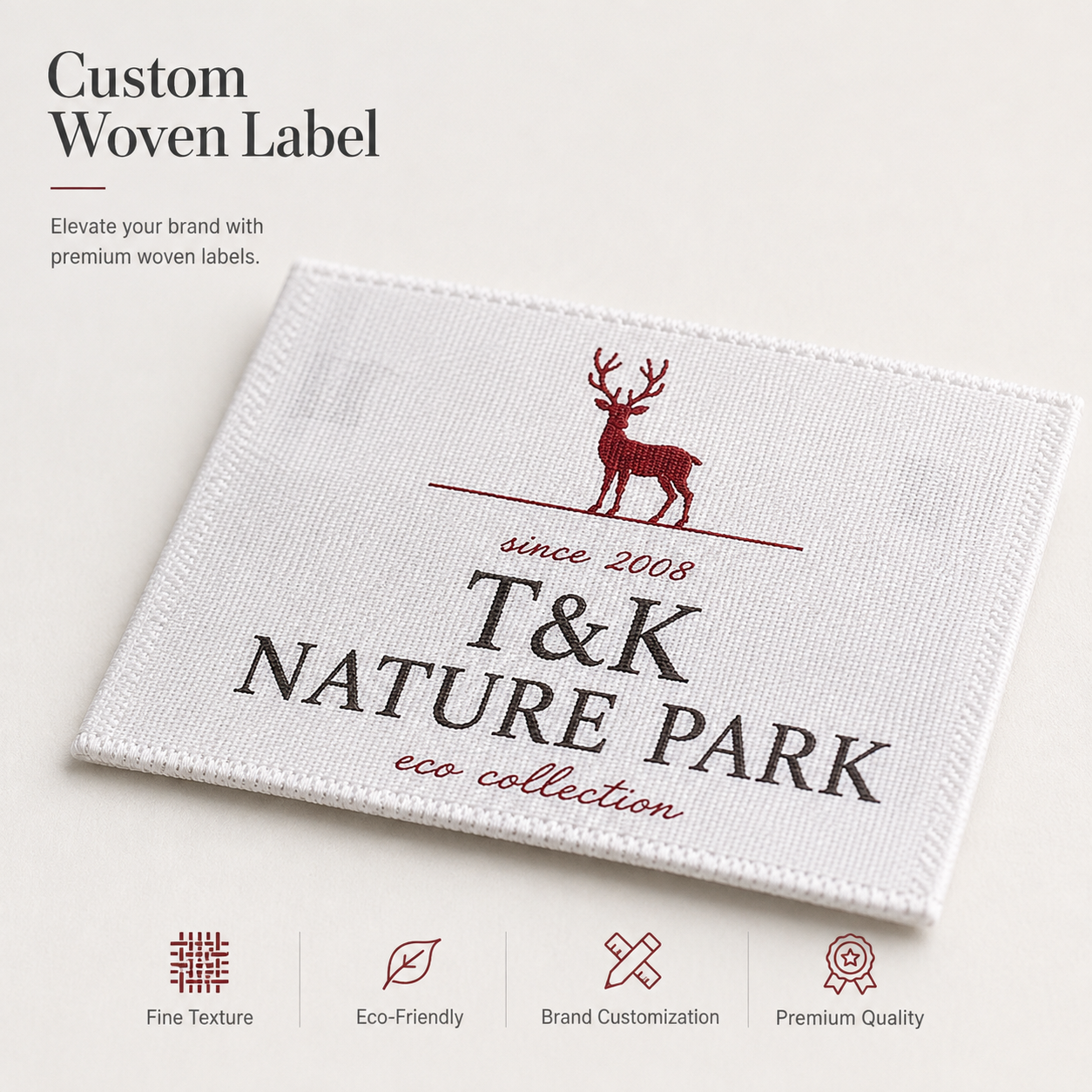
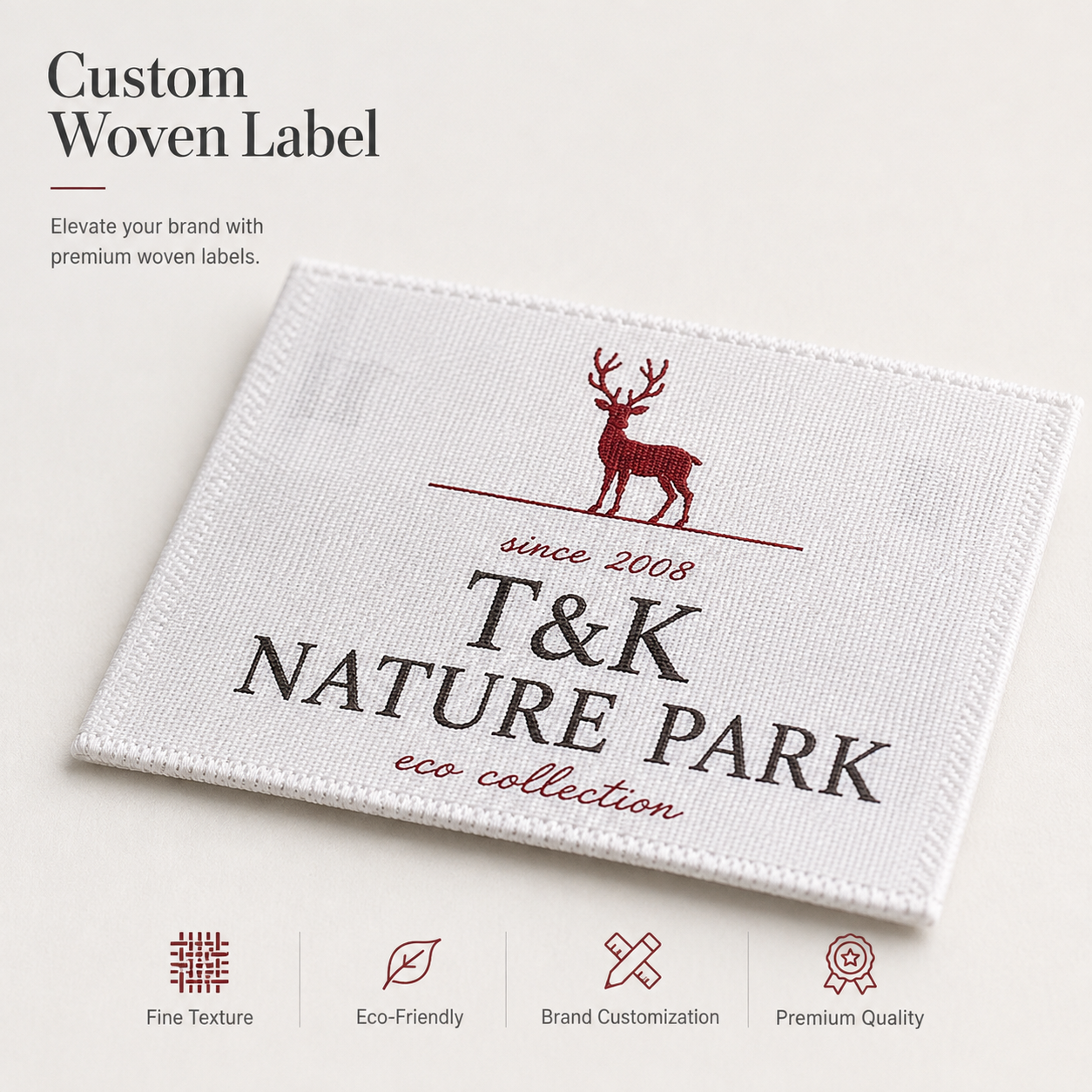

Custom Premium Woven Label
Custom Premium Woven Labels for Fashion Brands
Complete your garments with custom woven labels that bring clarity, texture, and considered detail to your brand presentation. From a discreet monogram to a finely detailed brand name, each label can be developed to complement your collection and the way your garments are made.
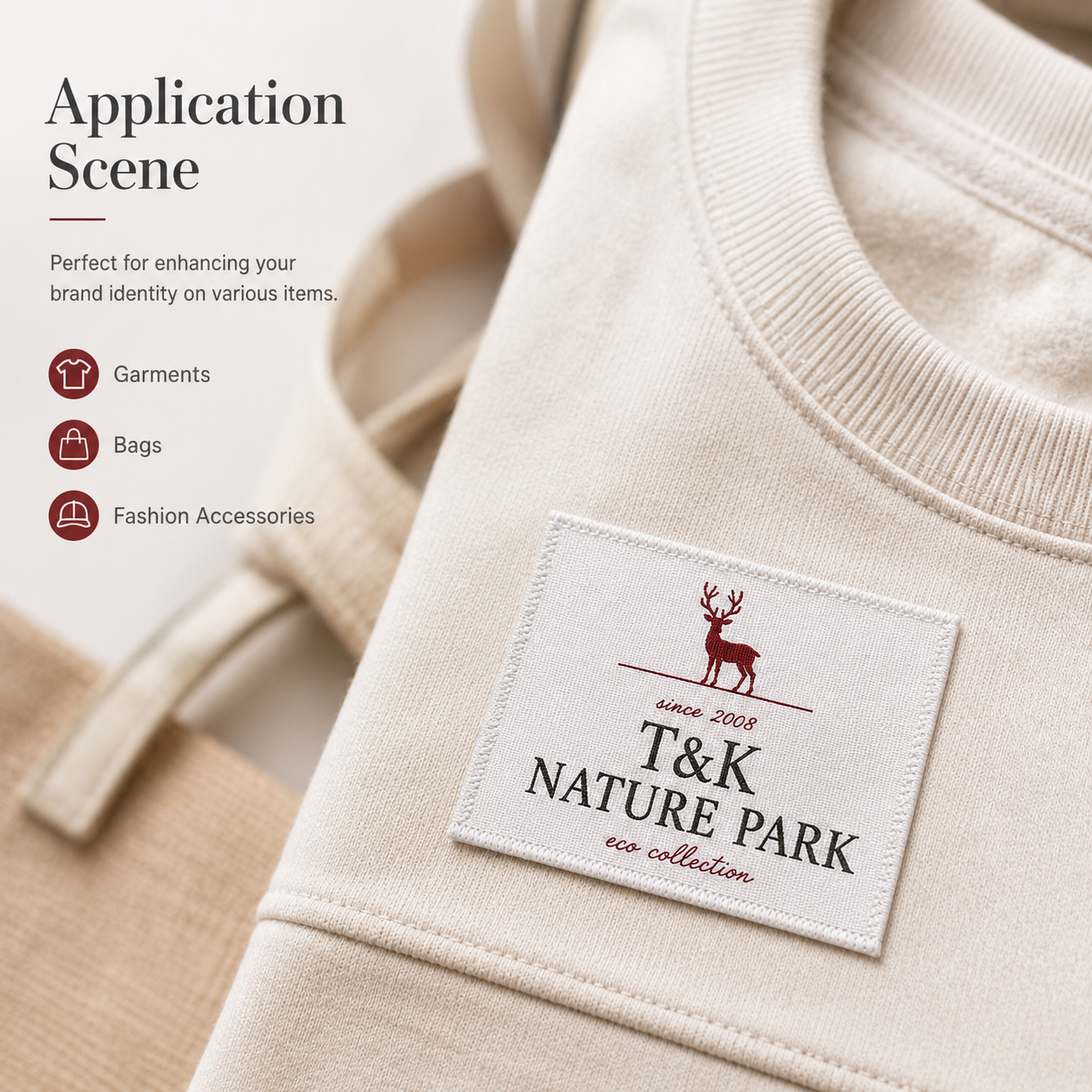
Suitable for designer clothing, tailored garments, knitwear, denim, outerwear, and accessories, these labels integrate the artwork into the woven structure. Customize the yarns, weave, dimensions, colors, folds, and edge finishing to achieve your preferred appearance and feel.
Fine Weaving for Defined Brand Details
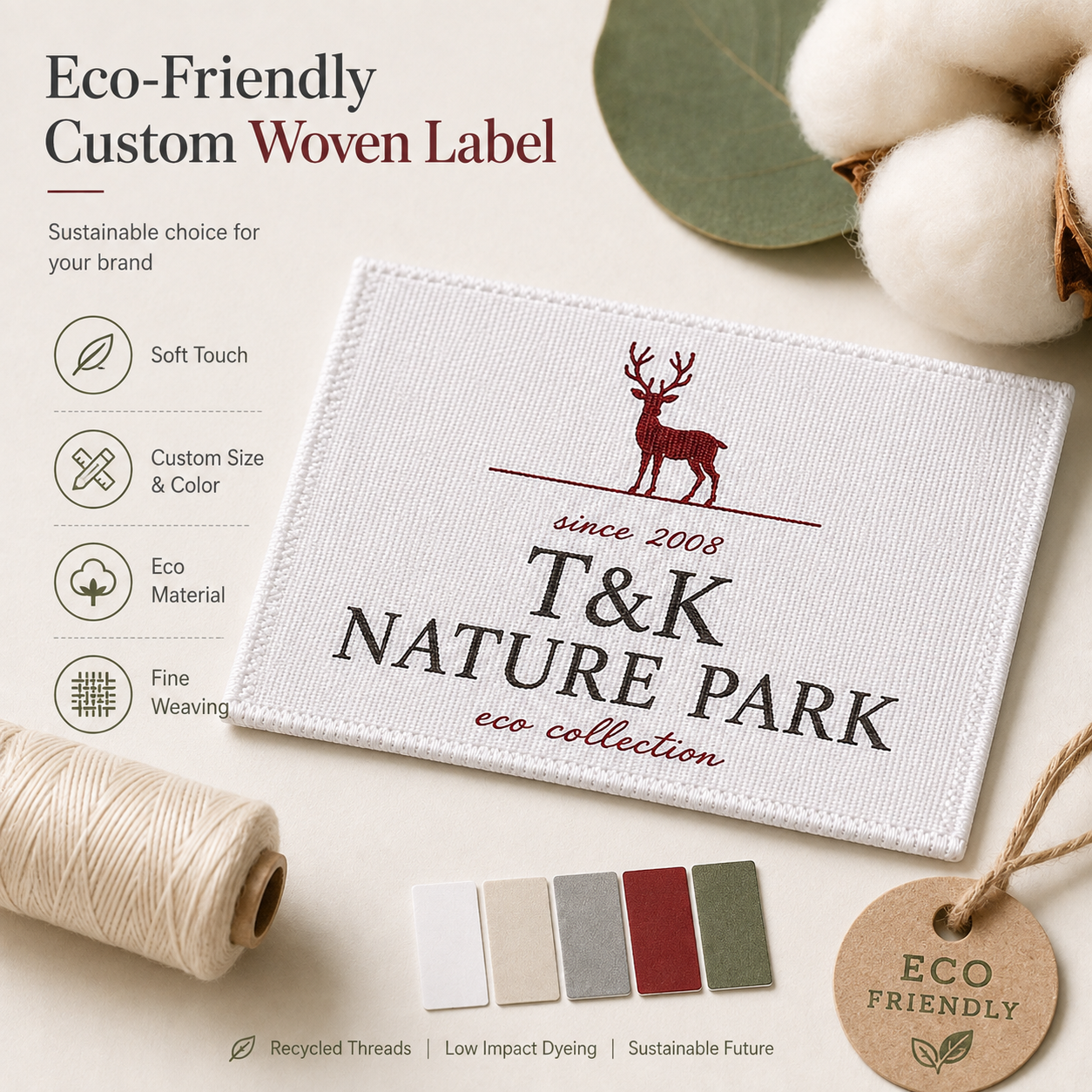
A refined woven label starts with a construction suited to the artwork. Fine-yarn damask weaving can support detailed logos and small lettering, while satin constructions offer a smoother, more lustrous background for suitable designs.
Weave density, yarn thickness, color contrast, and finished dimensions all influence the result. Increasing density alone does not guarantee a better label; it must be balanced with flexibility, clarity, and the intended garment application.
Artwork is reviewed at the actual label size to identify details that may need adjustment. Open lettering, suitable line widths, and adequate spacing help preserve the character of your logo.
Personalized Logos, Typography, and Colors
Create labels featuring your brand name, signature lettering, emblem, collection title, or short message. Design options can include:
Tonal branding for a subtle textile effect.
Contrasting lettering for clear recognition.
Borders and repeating motifs.
Selected lustrous or specialty yarn accents, where suitable.
Coordinated versions for different collections and garment sizes.
Matching main labels, side-seam labels, and size tabs.
Physical yarn references help establish the intended colors. Because weave structure and thread sheen affect appearance, labels should be reviewed under appropriate lighting rather than approved solely from a screen image.
A Considered Balance of Texture and Comfort
The label should suit both the garment’s appearance and its contact with the wearer. Yarn selection, weave structure, thickness, folds, and cut edges contribute to the finished feel.
A more substantial construction may work well on an outerwear brand patch, while a lighter, more flexible label may be preferable inside a blouse or fine-knit garment. For necklines and other skin-contact positions, assess a sewn sample for edge comfort, bulk, and movement.
A smooth surface or fine weave does not automatically guarantee comfort in every placement. The complete label-and-garment combination provides the most useful basis for approval.
Custom Dimensions and Finishing
Choose a format that fits your garment pattern and available sewing area. Options can include:
Straight-cut labels: Flat labels with agreed stitching allowances.
End-fold labels: Folded ends create a neat finish for surface attachment.
Center-fold labels: Suitable for seam insertion with artwork arranged on the visible panels.
Mitre-fold labels: Angled folded ends for selected hanging-loop or label constructions.
Specify the total cut dimensions, finished visible dimensions, fold direction, and sewing allowances. Important lettering should remain clear of folds and stitching.
Edge-finishing methods are selected according to the yarn composition and construction. The finished edges should be checked for neatness, fraying, stiffness, and suitability for the application.
Coordinated Labels Across Your Collection
Maintain a consistent identity while adapting labels to different garments. A collection may combine a main brand label, a separate size tab, and a compact external label using related colors and typography.
Each format should be developed for its own dimensions rather than simply reducing the main design. Smaller versions may require simplified artwork or adjusted spacing to remain readable.
Clear item references and approved artwork versions help distinguish similar labels during ordering and sewing-line use.
Care Performance and Lasting Readability
Woven graphics form part of the textile structure, but their long-term appearance still depends on yarn quality, dye selection, finishing, and garment care.
Testing on the intended garment can assess:
Colorfastness and possible color transfer.
Dimensional change after washing and drying.
Logo definition and overall appearance.
Edge condition and stitch security.
Label texture and comfort after care.
Provide any dry-cleaning, garment-dyeing, industrial-laundry, or special finishing requirements before sampling. A construction approved for one care process may need reassessment for another.
Sample Approval and Quality Review
Before bulk production, confirm the weave, yarn colors, artwork, dimensions, folds, edge finish, and packing requirements against a physical sample.
Quality review can include lettering clarity, weave consistency, loose threads, color alignment, dimensional tolerances, and fold accuracy. Approving these details creates a practical reference for the first order and future reorders.
Request a Custom Quotation
Send your logo artwork, finished dimensions, preferred texture, color references, fold style, quantity per version, and garment application. Include any requirements for softness, care performance, or coordination with existing trims so suitable options can be reviewed.
Custom premium woven labels are packed according to their dimensions, folds, surface details, and production requirements. Packing helps preserve the approved appearance and keep label versions clearly organized.
Options can include:
Counted inner packs: Agreed quantities for inventory control and garment assembly.
Separate version packing: Different logos, sizes, colors, and folds packed separately.
Fold protection: Labels arranged to help retain their finished shape.
Surface protection: Suitable wrapping or separation where required for delicate decorative yarns.
Roll supply: Available for suitable continuous constructions, with agreed repeat spacing and orientation.
Pack identification: Item references, quantities, and agreed batch information.
For coordinated label sets, the packing list should distinguish main labels, size tabs, and other components. Roll orders should state whether quantities are measured by label count or tape length.
Final packing quantities, carton dimensions, net weight, and gross weight are confirmed after approval. Store labels in clean, dry conditions away from moisture, direct sunlight, contamination, and excessive compression.